
The research behind Hedonia

What has been tested, and what has not?
Each of the three nutrients in Hedonia has been tested in randomized controlled trials in depression. A systematic review and meta-analysis in the American Journal of Psychiatry concluded that current evidence supports the adjunctive use of SAMe, Methylfolate and omega-3 with antidepressants to reduce depressive symptoms, and the 2022 WFSBP and CANMAT clinician guidelines give adjunctive omega-3 fatty acids their strongest rating for any nutrient in unipolar depression.
Those trials tested the nutrients individually. A trial of the finished three-in-one formulation is now being commissioned with Clinical Research Australia, to be registered publicly and published in the peer-reviewed literature. Hedonia is designed to be used under a doctor’s supervision, alongside existing care.
How much of each nutrient is in Hedonia, and why that much?
Named in the guidelines
Strongest nutrient evidence
Research-level amounts
1,440 mg of EPA, 15 mg of L-Methylfolate and 1,200 mg of SAMe a day. Each sits at or within the amount used in the published research on that nutrient.
Active folate form
The guidelines recommend Methylfolate and do not recommend plain folic acid.1 Hedonia uses the Methylated form, which the body can use without conversion.
Ultra-high EPA
The studies that found an effect used formulations where EPA made up most of the omega-3 content. In Hedonia it is an ultra-high-EPA formulation.
| Nutrient | In four capsules | In one capsule | Amount used in the research | In the 2022 guidelines |
|---|---|---|---|---|
| EPA omega-3 (OmegaTex®) | 1,440 mg | 360 mg | 1 to 2 g daily2 | Recommended1 |
| L-Methylfolate (Quatrefolic®) | 20 mg, providing 15 mg L-5-MTHF | 5 mg, providing 3.75 mg | 15 mg daily in the trial that found an effect3 | Recommended1 |
| SAMe (Adonat® Premium) | 1,200 mg | 300 mg | Within the range used across trials4 | Recommended1 |
| Total omega-3 | 1,800 mg | 450 mg | EPA at 60% or more of EPA plus DHA2 | EPA predominates |
| DHA | 36 mg | 9 mg |
Product labels state amounts per capsule and research states amounts per day. Both are given. Where this site gives an amount without saying which, it is the daily amount.
Quatrefolic® 5 mg supplies 3.75 mg of L-Methylfolate. Both figures describe the same ingredient.
Adjunctive use means added to existing treatment rather than replacing it.
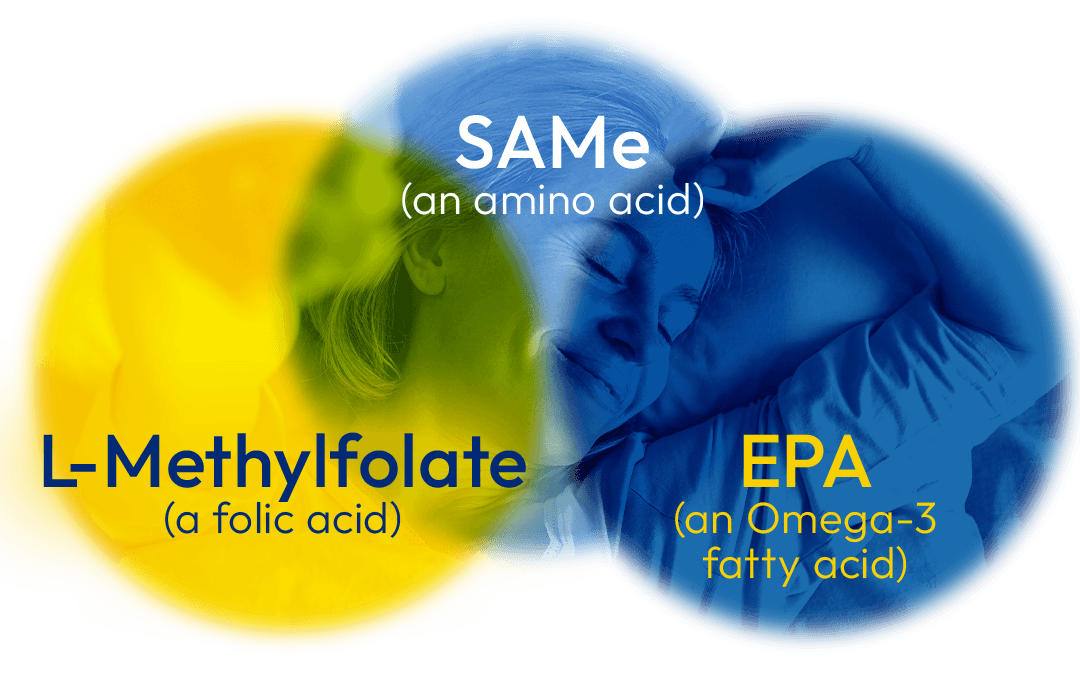
Why these three nutrients together?
The scientific case for combining these three nutrients, rather than using any one of them alone, is set out in a peer-reviewed paper by Hedonia’s founder and two of its scientific advisors:
Tobin D, Vuckovic A, Sarris J. Targeting divergent pathways in the nutritional management of depression. Nutrients. 2024;16(16):2806. doi:10.3390/nu16162806. PMID: 39203943.
The paper is open access and can be read in full.
The evidence, question by question
The productHedonia Medical Food
Hedonia is a medical food for the dietary management of the nutritional requirements associated with depression, intended for use under medical supervision alongside a physician-directed treatment plan. It provides three nutrients in one capsule: EPA omega-3, L-Methylfolate and SAMe. The directions are two capsules twice a day, i.e. four capsules daily.
Read the full page /science/hedonia-medical-food/
The categoryMedical Foods and Dietary Supplements: What Is the Difference?
A medical food is a distinct regulatory category in the United States, defined in the Orphan Drug Act, intended for the dietary management of a disease and used under medical supervision. A dietary supplement sits under different law and is intended for general use by healthy people. The two differ in their legal definition, their intended use, and the wording each is permitted to carry.
Read the full page /science/medical-food-vs-supplement/
The nutrientsEPA Omega-3 and Depression
EPA, or eicosapentaenoic acid, is a long-chain omega-3 fatty acid. Among nutrients studied in depression it carries the strongest guideline support: the 2022 WFSBP and CANMAT clinician guidelines give adjunctive omega-3 fatty acids their strongest rating for any nutrient in unipolar depression. Trials generally use formulations in which EPA predominates over DHA.
Read the full page /science/epa-omega-3-depression/
The nutrientsL-Methylfolate and Depression: Dose and Evidence
L-Methylfolate is the active form of folate, the form that crosses into the brain without needing further conversion. It has been studied as an addition to antidepressant treatment, most notably in a 2012 trial in which 15 mg a day improved response over an SSRI alone. The form is what distinguishes it from an ordinary folic acid supplement, and the clinical guidelines treat the two differently.
Read the full page /science/l-methylfolate-depression/
The nutrientsSAMe and Depression
SAMe, or S-adenosylmethionine, is the body’s principal Methyl donor and a central agent in the one-carbon cycle. In depression it has been studied mainly as an addition to antidepressant treatment, and a systematic review in the American Journal of Psychiatry concluded that current evidence supports the adjunctive use of SAMe, Methylfolate and omega-3 with antidepressants. In Hedonia it is chosen to work with the other two nutrients rather than on its own.
Read the full page /science/same-depression/
ComparisonsSt John’s Wort and Nutrient Approaches to Depression
St John’s Wort is a herbal extract. EPA omega-3 and L-Methylfolate are single nutrients the body already uses and obtains from food. The two have been studied to answer different questions: St John’s Wort mainly as an alternative to antidepressant medication, and these nutrients mainly for use alongside existing treatment. St John’s Wort also interacts with a wide range of medicines.
Read the full page /science/st-johns-wort-and-nutrients/
Using HedoniaTaking Nutrients Alongside an Antidepressant
Some nutrients have been studied specifically as additions to antidepressant treatment rather than as replacements for it. A systematic review in the American Journal of Psychiatry concluded that current evidence supports the adjunctive use of SAMe, Methylfolate and omega-3 with antidepressants to reduce depressive symptoms. Anyone taking prescribed medication should speak to their doctor before adding anything to it.
Read the full page /science/nutrients-alongside-antidepressants/
The evidenceWhat the Clinical Guidelines Say About Nutrients and Depression
Several independent bodies have reviewed the evidence for nutrients in depression, and they converge on nutrients used alongside existing treatment. The 2022 WFSBP and CANMAT clinician guidelines give adjunctive omega-3 their strongest rating for any nutrient in unipolar depression, and a systematic review in the American Journal of Psychiatry concluded that current evidence supports the adjunctive use of SAMe, Methylfolate and omega-3 with antidepressants.
Read the full page /science/nutrients-depression-guidelines/
Watch the science explained
What is a medical food, and why is Hedonia one?
A short film with Dr. Alexander Vuckovic, MD, explaining this part of the science behind Hedonia.
References
US Food and Drug Administration. Guidance for industry: frequently asked questions about medical foods, third edition. March 2023.
Orphan Drug Act, 21 USC 360ee(b)(3), definition of medical food.
21 CFR 101.9(j)(8), labelling of medical foods.
Tobin D, Vuckovic A, Sarris J. Nutrients. 2024;16(16):2806.
Sarris J, Ravindran A, Yatham LN, et al. World J Biol Psychiatry. 2022;23(6):424-455.
Why these three nutrients?
A short film with Dr. Alexander Vuckovic, MD, explaining this part of the science behind Hedonia.
References
Sarris J, Ravindran A, Yatham LN, et al. World J Biol Psychiatry. 2022;23(6):424-455.
Kelaiditis CF, Gibson EL, Dyall SC. Prostaglandins Leukot Essent Fatty Acids. 2023;192:102572.
Guu TW, Mischoulon D, Sarris J, et al. Psychother Psychosom. 2019;88(5):263-273.
Papakostas GI, Shelton RC, Zajecka JM, et al. Am J Psychiatry. 2012;169(12):1267-1274.
Firth J, Teasdale SB, Allott K, et al. World Psychiatry. 2019;18(3):308-324.
Using Hedonia alongside your treatment
A short film with Dr. Alexander Vuckovic, MD, explaining this part of the science behind Hedonia.
References
US Food and Drug Administration. Guidance for industry: frequently asked questions about medical foods, third edition. March 2023.
NCCIH. S-Adenosyl-L-Methionine (SAMe): In Depth.
Merck Manual Professional Edition. S-Adenosyl-L-Methionine.
Drugs.com. S-adenosylmethionine (SAMe).
Sarris J, Ravindran A, Yatham LN, et al. World J Biol Psychiatry. 2022;23(6):424-455.
A note on St John’s Wort. St John’s Wort is a herbal preparation, not a nutrient. It has been studied mainly as an alternative to antidepressant medication, while Hedonia’s nutrients are discussed for use alongside existing treatment under medical supervision.
Who advises on the science?
Dr. Alexander Vuckovic, MD
Founder and Chief Scientific Officer, HedoniaUSA Inc. A psychiatrist with more than 35 years of clinical experience, and an assistant professor of psychiatry, part-time, at an Ivy League medical school. Diplomate of the American Board of Psychiatry and Neurology and a Distinguished Life Fellow of the American Psychiatric Association. Co-author of the 2024 Nutrients paper and named inventor on the two US patents behind the formulation.
Derek Tobin, PhD
Scientific advisor. Lead author of the 2024 Nutrients paper setting out the rationale for the three-nutrient approach. Product Development and Clinical Science Manager at Epax Norway, and formerly a clinical researcher at GE Healthcare and BASF, with eight years of experience in omega-3 product development.
Professor Jerome Sarris, PhD
Scientific advisor. Executive Director of the Psychae Institute. Lead author of the 2022 clinician guidelines on nutraceuticals and phytoceuticals in psychiatric disorders, and co-author of the International Society for Nutritional Psychiatry Research practice guidelines on omega-3 fatty acids in major depressive disorder.
Professor Joseph Firth, PhD
Scientific advisor. Professor of Psychology and Mental Health at a leading UK university, whose research focuses on the role of nutrition, exercise and lifestyle interventions in the treatment of mental illness. He has published over 400 peer-reviewed papers and is a five-time recipient of the Clarivate Highly Cited Researcher award in Psychiatry and Psychology.
Safety information
Tell your doctor about every medicine you take before starting Hedonia, in particular any antidepressant.
IF YOU ARE PREGNANT, NURSING, DIAGNOSED WITH BIPOLAR DISORDER, AND/OR TAKING MAO INHIBITORS, YOU SHOULD CONSULT WITH YOUR DOCTOR FIRST.
Speak to your doctor first if you are taking anticoagulant (blood-thinning) medication, or levodopa for Parkinson’s disease.S1,S3 If you are having surgery, stop taking Hedonia two weeks beforehand.S2
What people report. In trials, side effects from these nutrients have generally been mild and no more common than with placebo, most often stomach upset or headache. Some people notice changes in sleep.S1,S2
The 2019 World Psychiatry meta-review of 33 meta-analyses reported good safety profiles across the nutrient supplements it assessed, with no evidence of serious adverse effects or contraindications with psychiatric medications.5
Do not stop or change a prescribed medication because you have started taking Hedonia.
Sources for this section
S1. Merck Manual Professional Edition. S-Adenosyl-L-Methionine. Full review July 2025.
S2. Drugs.com. S-adenosylmethionine (SAMe). Medically reviewed August 2025.
S3. National Center for Complementary and Integrative Health. S-Adenosyl-L-Methionine (SAMe): In Depth. National Institutes of Health.
References
References cited on this page
- Sarris J, Ravindran A, Yatham LN, Marx W, Rucklidge JJ, McIntyre RS, et al. Clinician guidelines for the treatment of psychiatric disorders with nutraceuticals and phytoceuticals: the WFSBP and CANMAT Taskforce. World J Biol Psychiatry. 2022;23(6):424-455. doi:10.1080/15622975.2021.2013041. PMID: 35311615.
- Kelaiditis CF, Gibson EL, Dyall SC. Effects of long-chain omega-3 polyunsaturated fatty acids on reducing anxiety and/or depression in adults: a systematic review and meta-analysis of randomised controlled trials. Prostaglandins Leukot Essent Fatty Acids. 2023;192:102572. doi:10.1016/j.plefa.2023.102572. PMID: 37028202.
- Papakostas GI, Shelton RC, Zajecka JM, Etemad B, Rickels K, Clain A, et al. L-Methylfolate as adjunctive therapy for SSRI-resistant major depression: results of two randomized, double-blind, parallel-sequential trials. Am J Psychiatry. 2012;169(12):1267-1274. doi:10.1176/appi.ajp.2012.11071114. PMID: 23212058.
- Peng TR, Cheng HY, Wu TW. S-Adenosylmethionine (SAMe) as an adjuvant therapy for patients with depression: an updated systematic review and meta-analysis. Gen Hosp Psychiatry. 2024;86:118-126. doi:10.1016/j.genhosppsych.2024.01.001. PMID: 38199136.
- Firth J, Teasdale SB, Allott K, Siskind D, Marx W, Cotter J, et al. The efficacy and safety of nutrient supplements in the treatment of mental disorders: a meta-review of meta-analyses of randomized controlled trials. World Psychiatry. 2019;18(3):308-324. doi:10.1002/wps.20672. PMCID: PMC6732706.
The full reference apparatus for each nutrient now lives on that nutrient’s own page beneath /science/, where it is attached to the statements it supports. This page cites only what it states itself.
Further reading from our scientific advisors
Our advisors publish widely on nutrition and mental health. The papers below are part of that wider body of work.
- Sarris J, Murphy J, Mischoulon D, Papakostas GI, Fava M, Berk M, Ng CH. Adjunctive nutraceuticals for depression. Am J Psychiatry. 2016;173(6):575-587.
- van der Burg KP, Cribb L, Firth J, Karmacoska D, Mischoulon D, Byrne GJ, et al. EPA and DHA as markers of nutraceutical treatment response in major depressive disorder. Eur J Nutr. 2020;59:2439-2447.
- Sarris J, Price LH, Carpenter LL, Tyrka AR, Ng CH, Papakostas GI, et al. Is S-adenosyl methionine (SAMe) for depression only effective in males? Pharmacopsychiatry. 2015;48(4-5):141-144.
- Firth J, Gangwisch JE, Borsini A, Wootton RE, Mayer EA. Food and mood. BMJ. 2020;369:m2382.
- Marx W, Lane M, Hockey M, Aslam H, Berk M, Walder K, et al. Diet and depression. Mol Psychiatry. 2021;26(1):134-150.
Press and company facts
Hedonia is a brand of HedoniaUSA Inc., based in Bethesda, Maryland. The press and facts page carries the company facts, product facts, downloadable wording and machine-readable blocks.